
What is induction heating?
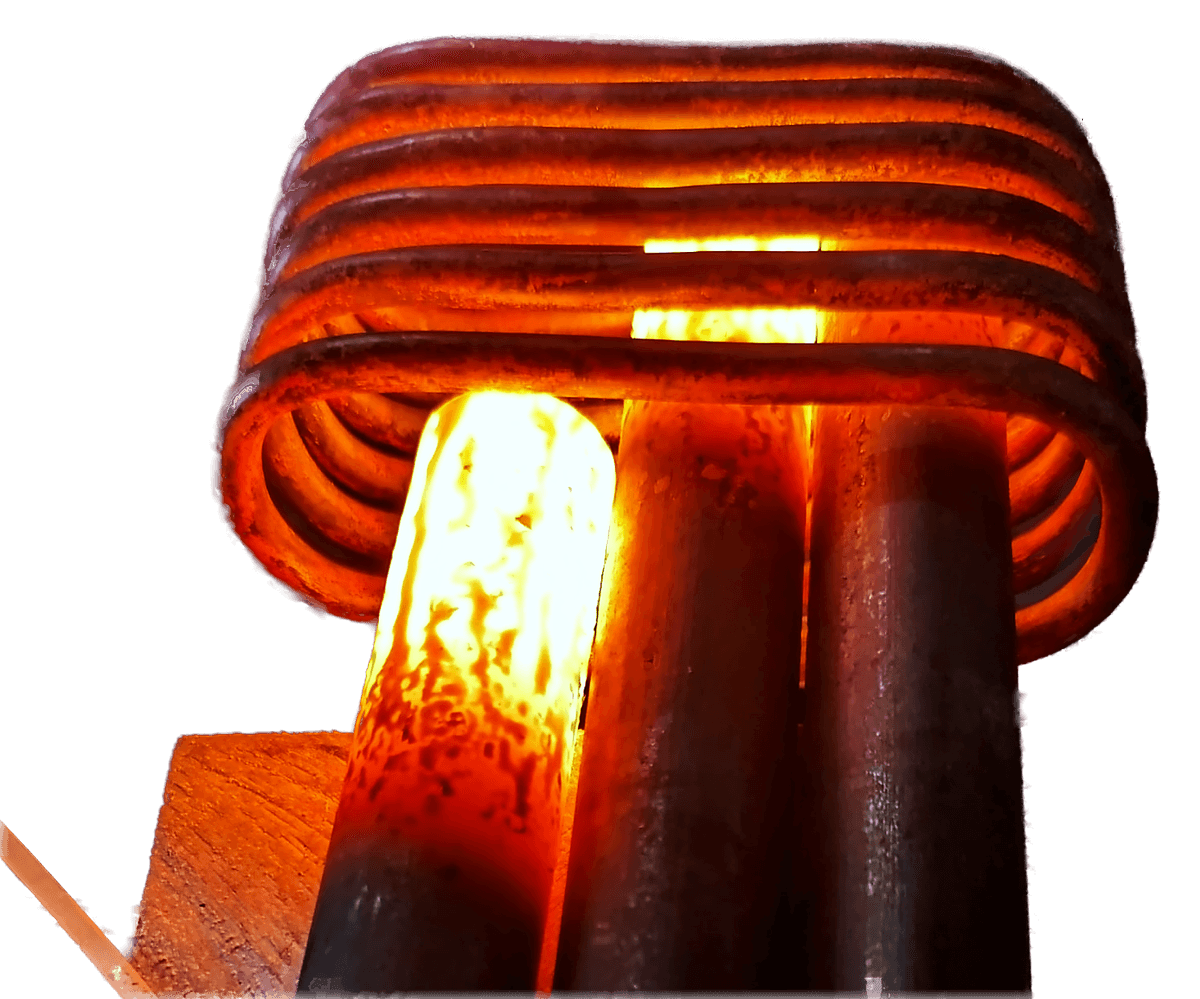
No flame, no contact, no furnace. The heat is generated inside the metal itself, by the metal itself, and the coil decides where.
The principle
Pass an alternating current through a copper coil and you create a magnetic field that reverses direction as fast as the current does. Put a piece of metal inside that field and the field induces circulating currents in it, called eddy currents. The metal has electrical resistance, so those currents dissipate energy as heat.
That is the whole of it. Faraday's law in one direction, resistive heating in the other. The consequences, though, are what make it useful in a factory:
- The heat is made inside the part. Nothing has to conduct heat into it from outside, so there is no waiting for a surface to warm and the heat to soak inward.
- Nothing touches the part. No electrode, no flame, no contact resistance, and no consumable to replace.
- Only the part gets hot. Copper is a poor place for eddy currents to dissipate, and the coil is water cooled anyway, so the coil stays cool while the workpiece glows.
- The coil decides where. Shape the coil to the feature and the heat goes to the feature. This is the single biggest practical advantage over a furnace.
Why the heat stays near the surface
Alternating current does not distribute itself evenly through a conductor. It crowds towards the surface, and the higher the frequency the harder it crowds. This is the skin effect, and in induction heating it is not a nuisance but the main control you have.
The depth at which the current density has fallen to about 37 percent of its surface value is called the reference depth or skin depth. For a given material it follows:
δ = √( ρ / (π · f · μ) )
δ reference depth ρ electrical resistivity f frequency μ magnetic permeability
Two things fall out of that expression, and both matter every day on a shop floor.
Higher frequency gives a thinner heated layer. Reference depth goes as the inverse square root of frequency, so multiplying the frequency by four halves the depth. That is why hardening a shallow case uses high frequency and heating a billet through its section uses medium frequency.
The material changes the answer. Resistivity rises substantially as steel heats, which increases the reference depth during the cycle. Permeability matters even more, and that leads to the next point.
Work the numbers with the reference depth calculator
What happens at the Curie point
Steel is ferromagnetic at room temperature, with a relative permeability in the tens or hundreds. Above roughly 770 degrees Celsius, the Curie temperature, it loses that property and becomes effectively non-magnetic, with a relative permeability of about one.
Look at the expression again and you can see what that does. Permeability sits underneath a square root in the denominator, so a collapse from around 40 to 1 multiplies the reference depth by about six on its own. Resistivity is rising at the same time, which pushes it further: the combined effect is roughly a seventeen-fold increase. In the middle of a heating cycle, the depth at which energy is being deposited suddenly jumps.
This is why induction heating cycles are not simply "apply power for N seconds". The coupling between coil and workpiece changes as the part passes through the Curie point, and a machine designed for the job accounts for it. It is also why a pyrometer in a closed loop is worth more than a longer timer.
What an induction system is made of
Four things, and the fourth is the one people underestimate.
- The power supply. Converts mains AC into high frequency AC at the required power. Modern designs use IGBT switching, which is more efficient and much more compact than the thyristor and valve equipment it replaced. We build these from 5 kW to 500 kW.
- The cooling. The coil and the semiconductors are water cooled, using demineralised water so nothing scales up or conducts where it should not. On hardening machines there is a second, separate quench circuit.
- The handling. Whatever moves the part into the coil, holds it, rotates it, traverses it, quenches it and takes it away. On a scanner this is the machine. On a bench brazing cell it is a fixture and an operator.
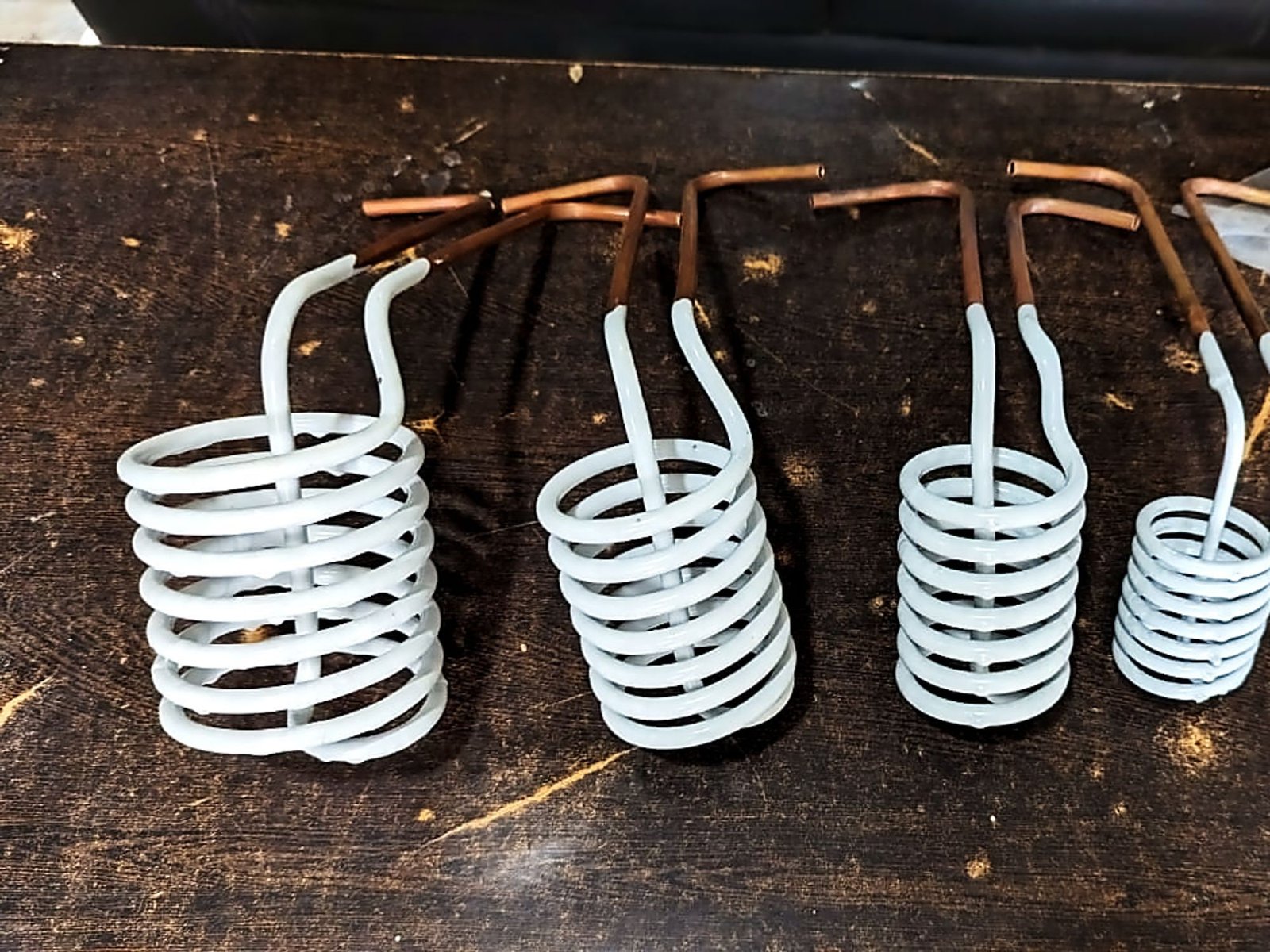
- The inductor. The copper coil itself. It is tooling, it is component-specific, and it determines whether the result is uniform or patchy. Two identical power supplies with different coils will give you different parts.
What can and cannot be heated
Anything electrically conductive can be heated by induction. How efficiently depends on resistivity and, for steels, on magnetism.
- Steel and cast iron heat very well. They are resistive and they are magnetic below the Curie point, which adds hysteresis heating on top of the eddy current heating. This is the easy case.
- Copper and aluminium heat, but need more effort. Their low resistivity means the induced currents dissipate less energy, and they are not magnetic. Perfectly workable, just a different design point.
- Non-conductors cannot be heated directly. Plastics, ceramics and glass have to be heated through a conductive susceptor, or by some other means entirely.
For hardening specifically there is a second requirement beyond conductivity: the steel needs enough carbon to form martensite. Medium and high carbon steels and alloy steels harden; low carbon steel does not, unless it has been carburised first.
Choosing power and frequency
These are two separate decisions and confusing them is the most common mistake in specifying a machine.
Power decides how fast. It follows from the mass you have to heat, how many degrees you have to raise it, the material's specific heat, and the cycle time you need. Divide by a realistic system efficiency and you have your first-pass figure.
Frequency decides how deep. It follows from the case depth or the through heating you need, via the reference depth relation above.
Two machines with the same power rating can serve different processes when their frequencies and coils differ. We build systems from 5 kW to 500 kW and select the frequency around your component and heating requirements.
Estimate the power for your part
Where to go next
If you know the process you need, the application pages explain each one and what it requires:hardening,brazing,billet heating,shrink fitting andfive more.
If you want the numbers behind case depth, readfrequency, power and case depth. If you are choosing a steel, readsteels for induction hardening. If you are comparing induction against what you already run, readinduction versus furnace heating.
Technical references
- Faraday’s law of induction and the standard electromagnetic reference-depth relation, as given in any undergraduate electromagnetics text.
- The Curie temperature of plain carbon steel, approximately 770 degrees Celsius, is a standard material constant.