
Induction brazing machines
Repeatable brazed joints with heat placed only where the filler must flow. Single and double station.
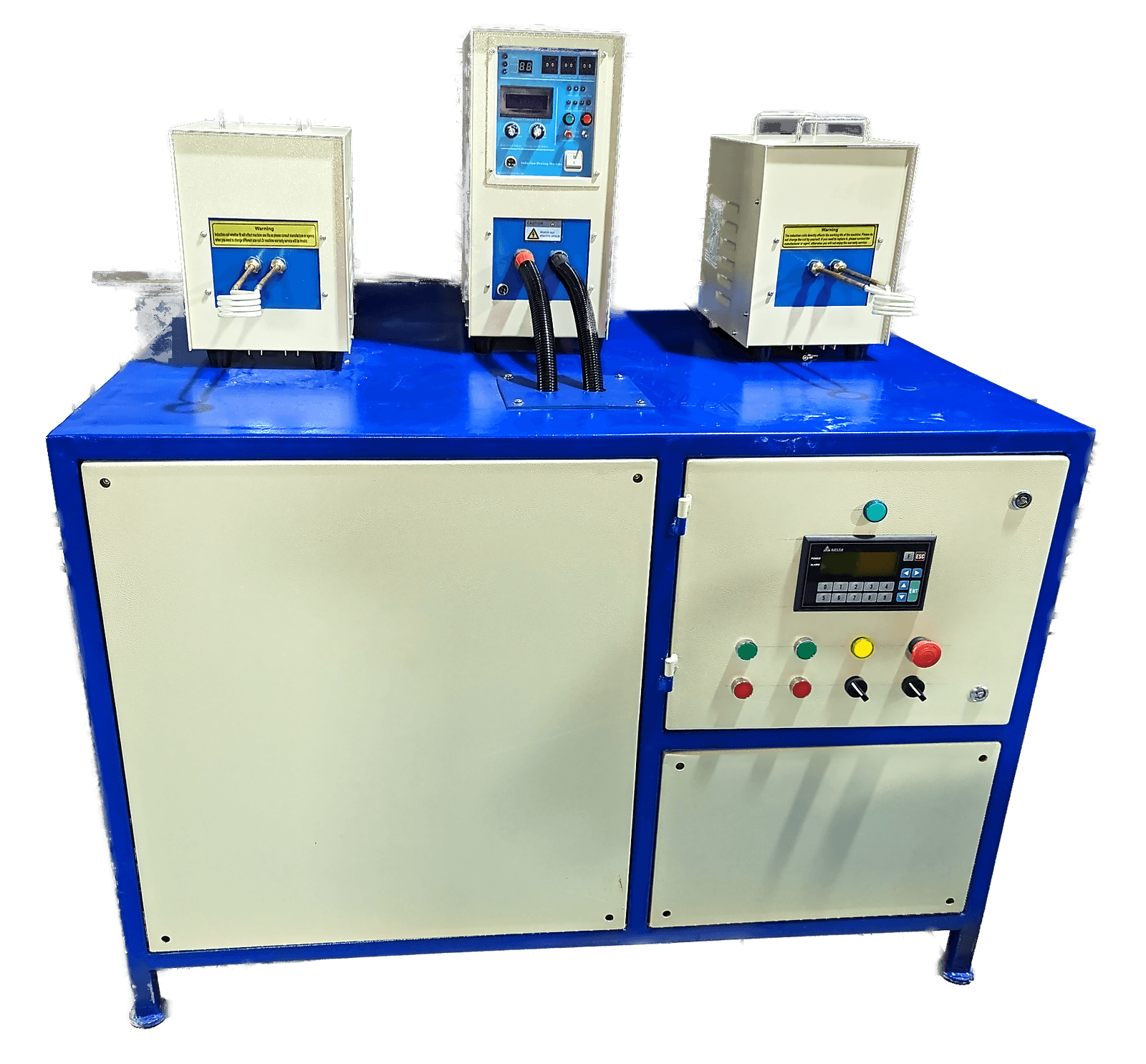
Brazing joins two parts with a filler metal that melts below their melting points and is drawn into the joint by capillary action. The difficulty is never melting the filler; it is getting the whole joint to the right temperature at the same moment, every time, without overheating anything nearby.
Induction is well suited to this because the heat is placed by the coil. A coil wound to the shape of the joint heats the joint and little else. The cycle is timed rather than judged, so the operator’s skill stops being the variable that decides whether the joint is sound.
We build brazing machines including the ABE-25AB double station machine, where one station heats while the operator loads the other, and an ABE-60AB ultra high frequency machine for work where a very shallow, very fast heat is wanted. Machines can be supplied with a DM water chiller for continuous duty.
Technical specifications
- Typical power class15 kW to 60 kW for brazing work
- FrequencyHigh and ultra high frequency
- StationsSingle or double station
- CoolingDM water chiller available
We confirm the final configuration against your component, material and production requirements.
Questions engineers ask
Why a double station machine?
Because the operator is the bottleneck, not the heat. On a manual brazing cell most of the cycle is loading, positioning flux and filler, and unloading. With two stations the machine heats one while the operator works on the other, so the power supply is busy most of the time instead of a third of it.
Can induction brazing be automated?
Yes. We build PLC and CNC controlled automatic systems around the same power supplies, with part handling designed to the component.
What is ultra high frequency used for?
Very shallow, very fast heating. The higher the frequency the thinner the layer the current flows in, so UHF concentrates energy in a small surface region. It suits fine work, small joints and thin sections where a lower frequency would heat too much of the surrounding metal.
Related processes
Industries served
Tell us about the part.
Send a drawing, the material, the case depth or temperature you need, and your production rate. Our engineers will help define the right machine for your process.