
Induction hardening machines, designed and built in India
Vertical and horizontal hardening machines for shafts, gears, bushes, axle shafts and flywheel rings.
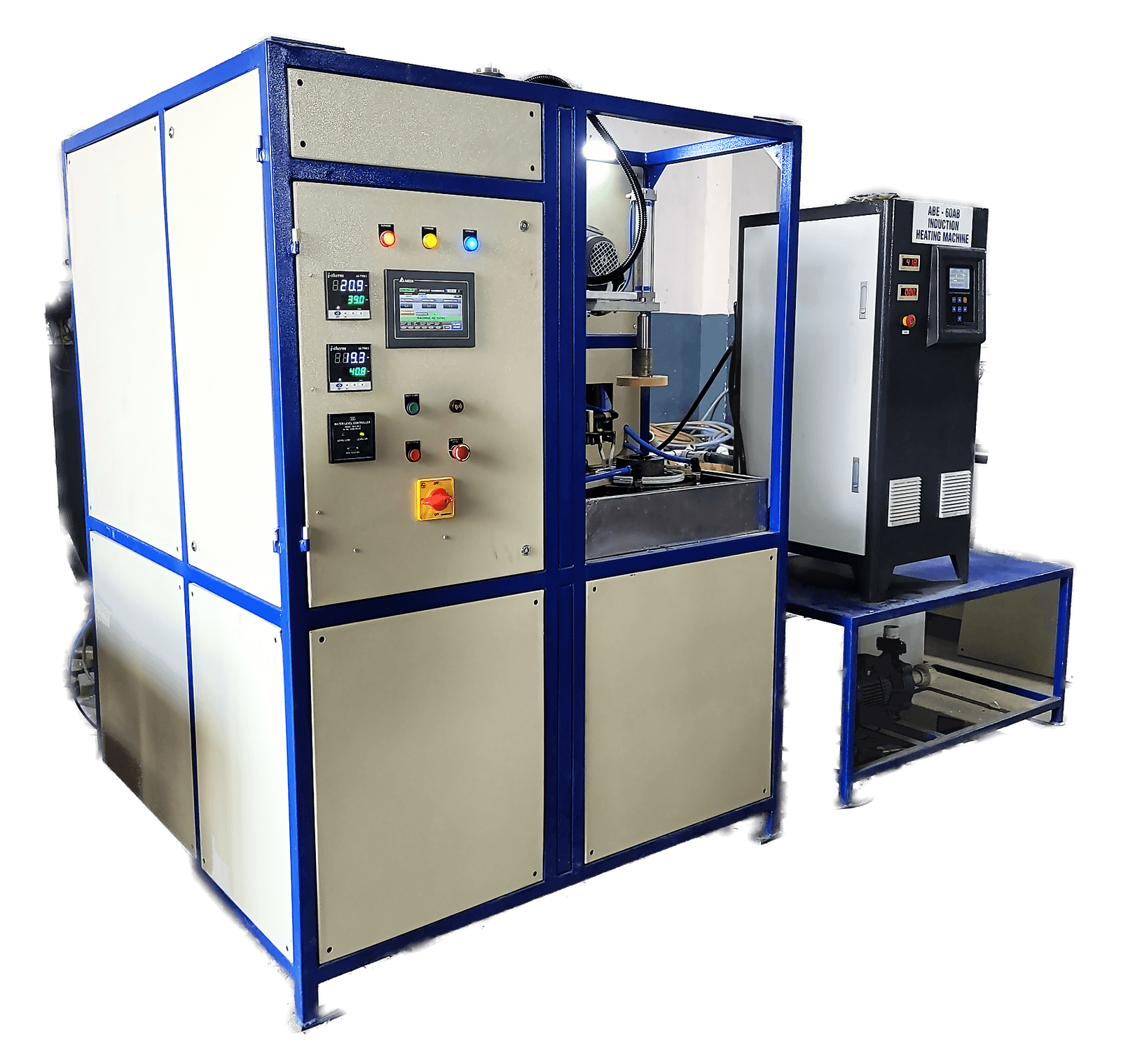
We use induction hardening to develop a wear-resistant surface while retaining the properties you need in the core. The heating and quenching cycle depends on your steel grade, component geometry and required case depth.
A.B. Enterprises (AB Induction) has designed and built induction machines at our works in N.I.T. Faridabad, Haryana, since 2001. We build hardening machines around this process in both vertical and horizontal configurations, manual and PLC controlled, single and double station, for auto component, tractor, JCB and hand tool manufacturers.
Our PLC controlled vertical scanner supports ABE-40 kW to ABE-120 kW power supplies, shaft diameters from 20 mm to 120 mm, case depths from 0.8 mm to 5 mm and travel from 10 mm to 1500 mm. We select the configuration for your part, with integrated DM water cooling and quench circulation.
Beyond the standard range, we design machines for specific components: axle shafts, flywheel starter rings, sledge hammer heads, JCB and tractor parts.
Case depth is the result of frequency, power density and heating time together. Our guide to frequency, power and case depth, the reference depth calculator and our notes on steels for induction hardening explain how a cycle is developed.
Technical specifications
- Shaft diameter20 mm to 120 mm0.79 in to 4.72 in
- Case depth0.8 mm to 5 mm0.031 in to 0.197 in
- Travelling length10 mm to 1500 mm0.39 in to 59.1 in
- Power suppliesABE-40 kW to ABE-120 kW
- ConfigurationsVertical and horizontal, manual or PLC, single or double station
- CoolingInbuilt DM water cooling and quenching water circulation
We confirm the final configuration against your component, material and production requirements.
Types of induction hardening machine
The component decides the configuration: how long it is, whether it hangs true, and how many features need hardening in one setup.
Configurations
- PLC controlled vertical hardening scannersA scanning hardening machine: the part traverses through the coil while quench follows behind it.
- Horizontal hardening machinesFor parts that must be supported along their length, or processed through stations in line.
- Flywheel ring hardening and shrink fitting machinesTwo processes on one component: hardening the starter ring gear, and shrink fitting it onto the flywheel.
- Laser hardening machinesLocalised surface hardening with self-quenching and very little distortion.
Hardening machines we have built
- Axle shaft hardening on a vertical scannerHardening a shaft longer than any coil could heat at once.
- Sledge hammer head hardening, double stationTwo stations, because the operator was the bottleneck and not the heat.
- Flywheel starter ring hardening at 120 kWHardening a starter ring gear all the way round, at consistent depth.
Plan the case depth
- Frequency, power and case depthFrequency decides where the energy goes. Power decides how fast it gets there. Time decides how far it spreads.
- Steels for induction hardeningEnough carbon to form martensite, and a prior structure that lets the carbon dissolve in the seconds available.
- Reference depth calculatorHow deep the induced current flows, for a given material and frequency.
Questions engineers and buyers ask
What case depth can you achieve?
Our PLC controlled vertical scanner covers case depths from 0.8 mm to 5 mm. We develop the cycle around your steel grade, part geometry and hardness requirements, then confirm the result on your component.
Which steels can be induction hardened?
Steels with enough carbon to form martensite: medium and high carbon steels such as C45, EN8, EN19 and EN31, alloy steels such as 4140, 4340 and 8620, and nodular and grey cast irons. Low carbon steel will not harden usefully without carburising first.
Vertical or horizontal?
Vertical scanners suit long slender parts that hang naturally and traverse through a coil, such as shafts and axle shafts. Horizontal machines suit parts that need supporting along their length, or where several stations run in line. We build both.
Do I need to temper after hardening?
Usually yes. As-quenched martensite is hard but brittle. A tempering cycle trades a little hardness for a large gain in toughness. Induction tempering can be built into the same machine so the part is hardened and tempered in one flow.
What shaft diameters can you harden?
Our PLC controlled vertical scanner covers shaft diameters from 20 mm to 120 mm. Configurations include ABE-25AB stationary hardening up to 30 mm, ABE-50AB up to 60 mm, ABE-60AB up to 80 mm and ABE-120AB up to 120 mm. We confirm suitability against your part and process.
Can you build a machine for my specific component?
Yes. Beyond the standard range we design hardening machines for specific components, including axle shafts, flywheel starter rings, sledge hammer heads, and JCB and tractor parts. Send us your drawing, material and production rate through the quote form.
Where are your induction hardening machines made?
At our own works at Plot No. 89, Bhakri Industrial Area, N.I.T. Faridabad, Haryana, where A.B. Enterprises has designed and built induction machines since 2001. Our design, production, quality control, research and development, and testing teams work together there. You are welcome to arrange a visit.
Do you supply machines outside India?
Yes. Contact us with your destination, electrical supply and project requirements. We will discuss a suitable machine and the delivery arrangements for your location.
Related processes
- Induction hardeningA hard, wear-resistant case on a tough core, in seconds, with the heat placed exactly where you want it.
- Induction temperingTrading a little hardness for a lot of toughness, in line with the hardening machine.
- Induction shrink fittingAssembling interference fits by expanding the outer part instead of forcing it on.
Industries served
- Automotive componentsShafts, gears, bushes, axle shafts and flywheel rings, at production rate.
- Tractor and agricultural equipmentParts that work in soil and abrasion, where wear resistance decides service life.
- Construction and earthmoving equipmentPins, bushes and linkage components that carry load and abrasion together.
- Hand toolsSledge hammers, claw hammers, chisels, pick axes and hoes, forged and hardened.
How buying a machine works
- Send us the part. Your drawing, material grade, the zone to be treated, the case depth or temperature you need, and your production rate. If some details are still open, we can work through them with you.
- We review your component. Our team will look at your requirements and ask for any details we need to assess the application.
- We discuss the process. We will work through the power, frequency, coil, handling, cooling and controls with you.
- We prepare your proposal. We set out the machine configuration and scope. Ask us to confirm installation and commissioning, operator training, warranty and recommended spares in your proposal.
Send a quick enquiry
Tell us about the part you need to harden. Our engineers will come back to you to define the right machine.
Tell us about the part.
Send a drawing, the material, the case depth or temperature you need, and your production rate. Our engineers will help define the right machine for your process.